Regulatory Update · EU Market Compliance
Enforcement Date
EU PPWR — 12 August 2026
Regulation (EU) 2025/40 · Replaces PPWD 94/62/EC
Applies to all packaging placed on the EU market
What PPWR Is and Why It Affects Every Umbrella Exporter Selling into the EU
On 12 August 2026, the EU's Packaging and Packaging Waste Regulation (PPWR, Regulation (EU) 2025/40) becomes fully mandatory. It replaces the 30-year-old Packaging and Packaging Waste Directive (94/62/EC) and introduces a critical change that every exporter selling packaged goods into the EU needs to understand: a Directive required transposition into national law by each Member State, creating fragmented requirements across countries. A Regulation applies directly and uniformly across all 27 EU member states from day one.
For umbrella brands, distributors, and OEM buyers sourcing for the EU market, PPWR is not a distant sustainability initiative. It is a current legal requirement that applies to every piece of packaging that enters the EU — the poly bag around an individual umbrella, the printed retail box, the master carton, the stretch wrap on a pallet, and any void-fill inside the box. Non-compliance can result in goods being rejected at EU borders, EPR registration penalties, and retail delisting.
→ Topumbrella has reviewed PPWR requirements across our packaging materials and OEM supply chain. Contact our team via topumbrella.com to discuss packaging compliance for your umbrella order.
Who Must Comply — and What Packaging Is Covered
PPWR applies to all businesses placing packaging on the EU market: manufacturers, importers, distributors, and retailers. For umbrella exporters, this includes B2B bulk trade (where the EU entity handling customs clearance typically takes on EPR registration) and B2C cross-border e-commerce (where the exporting manufacturer may be deemed the first market introducer and must complete EPR registration directly).
All packaging types are covered — primary, secondary, tertiary, and service packaging. For a typical umbrella order destined for the EU, this means:
| Packaging Type | Examples for Umbrella Orders | PPWR Coverage |
|---|---|---|
| Primary | Individual poly bag, retail box, hang tag sleeve | ✅ Full requirements |
| Secondary | Inner carton, shrink wrap bundles | ✅ Full requirements |
| Tertiary | Master carton, pallet wrap, strapping | ✅ Full requirements |
| Product accessory | Functional fabric umbrella sleeve (part of the product) | ⚠️ Not packaging — confirm classification |
The Self-Audit Checklist: Four Areas to Review Before 12 August 2026

① Packaging Scope — Know Exactly What You're Declaring
The first step is producing a complete packaging Bill of Materials (BOM) — every material that touches or wraps your umbrella on its journey to the EU end customer. This includes items that are easy to overlook: the tape sealing the master carton, the bubble wrap or foam around individual umbrellas, the hang tag plastic sleeve, and any pallet stretch film. The distinction between "packaging" and "product accessory" matters: a functional fabric umbrella carry sleeve that is part of the product's intended use is generally not packaging. A decorative paper tissue wrapping inside the retail box is.
② Hazardous Substance Compliance — Effective 12 August 2026
From 12 August 2026, all packaging materials must meet the combined concentration limit of Lead + Cadmium + Mercury + Hexavalent Chromium ≤ 100 mg/kg. This applies to all packaging materials — plastics, papers, inks, adhesives, and coatings. For umbrella packaging, the materials most likely to require testing or supplier confirmation are: printed retail boxes (inks and coatings), laminated or composite bags (adhesive layers), and metallic or specialty finishes on hang tags.
Additionally, packaging with waterproof treatment or plastic film coating should be assessed for PFAS content. While PPWR does not yet specify a PFAS threshold equivalent to its heavy metals limit, the broader EU PFAS regulatory environment — including REACH restrictions phasing in from 2026 — means that total fluorine screening on treated packaging films is increasingly advisable for EU market access.
Documentation required: EU Declaration of Conformity (DoC) and technical documentation confirming hazardous substance compliance. This must be produced and available for inspection from 12 August 2026. Retain for a minimum of 5 years.
③ Design for Recyclability (DfR) — The Structural Change Most Suppliers Are Not Ready For
PPWR requires that all packaging placed on the EU market be designed to be recyclable. For umbrella packaging, the most common structural issues are:
Multi-layer composite bags (paper-plastic, aluminium-plastic) — inseparable layers make recycling impossible. These must be phased out or replaced with single-material alternatives.
Non-removable BOPP laminate on retail boxes — standard gloss lamination on printed cartons is not recyclable in most EU paper streams. Switch to uncoated board, aqueous coating, or peelable water-based laminate.
Single-material PE or PP umbrella poly bags — these are recyclable and compliant. Confirm material composition with your packaging supplier and retain supplier declarations.
④ Minimisation and Labelling — What's Coming and When
PPWR restricts unnecessary packaging: the empty space ratio inside retail boxes must be justified, and void-fill materials (foam, bubble wrap) should be minimised — paper-based alternatives are preferred. This is already best practice for many experienced buyers, but it will become an enforceable requirement with documentation implications.
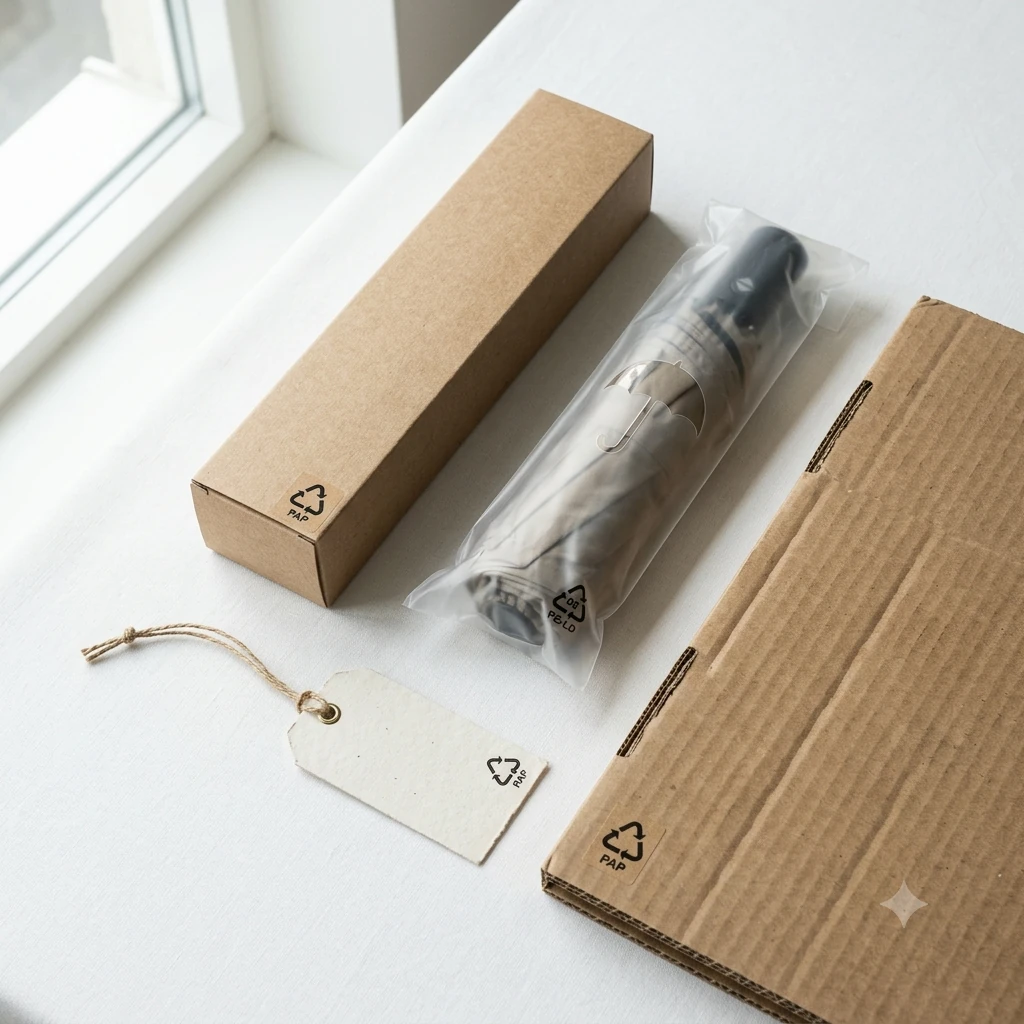
Harmonised consumer sorting labels — standardised pictograms indicating how to separate and dispose of each packaging component (e.g., PE, PP, PAP markings) — will be required on packaging from 12 August 2028 (subject to the implementing act timeline). Brands with long product development cycles should factor this into artwork and packaging design decisions made today, to avoid a reprint requirement when the labelling mandate takes effect.
| Date | Requirement | Action for Umbrella Exporters |
|---|---|---|
| 12 Aug 2026 | Heavy metals limit, DfR rules, DoC requirement, EPR registration | Complete supplier testing, switch non-recyclable packaging, register for EPR |
| 12 Aug 2028 | Harmonised consumer sorting labels mandatory on packaging | Update packaging artwork to include EU sorting pictograms (PE, PP, PAP etc.) |
| From 2030 | Minimum recycled content in plastic packaging; 70% recycling rate targets | Evaluate transition to recycled-content plastic bags and packaging materials |
| By 2040 | All packaging recyclable in economically viable way | Long-term packaging redesign roadmap |
EPR Registration: The Step Most Exporters Miss
Extended Producer Responsibility (EPR) registration is a separate and parallel obligation under PPWR that applies to all businesses placing packaging on the EU market. For B2B bulk trade, the EU entity handling customs clearance generally assumes EPR registration duties. For B2C cross-border e-commerce, the exporting manufacturer — regardless of their physical location — is treated as the first market introducer and must register directly with national authorities in each EU member state where goods are sold.
EPR registration requires reporting the weight and material type of each packaging category annually. Registration application volumes have surged ahead of the August 2026 enforcement date, with standard processing timelines extending. If you are selling directly to EU consumers, this step should be initiated immediately — not after the enforcement date.
How Topumbrella Is Supporting PPWR Compliance for OEM Buyers

Packaging BOM Review: We can provide a full packaging material breakdown for your OEM order — including material type, weight, and recyclability classification for each packaging component — to support your EU compliance documentation.
Single-Material Packaging Options: Single-material PE poly bags and uncoated or water-based-coated kraft paper retail boxes are available as standard options for EU-destined umbrella orders. Composite laminate packaging can be phased out on request.
Hazardous Substance Declarations: Supplier declarations confirming heavy metals compliance (Pb + Cd + Hg + Cr⁶⁺ ≤ 100 mg/kg) are available for our standard packaging materials. For custom packaging specifications, we can advise on testing requirements and timelines.
Labelling Preparation: For buyers planning packaging artwork ahead of the 2028 sorting label mandate, we can incorporate EU recycling pictogram positions into retail box and poly bag artwork during the OEM design process.
→ For our full sustainability and compliance program — including BSCI, SEDEX, SGS PFAS-free, GRS, and Higg FEM — see our Certifications page.
Sourcing Umbrellas for the EU? Let's Talk PPWR Compliance.
Our team can provide packaging BOMs, material declarations, and compliant packaging options for your EU umbrella order. Contact us before your next production run.
Contact Us →Frequently Asked Questions
Regulation (EU) 2025/40 (PPWR) · In force: 11 February 2025 · Applies: 12 August 2026 · Replaces Directive 94/62/EC · This article is for informational purposes and does not constitute legal or compliance advice. Seek independent professional advice for your specific situation.