
Factory Insight · PFAS-Free Production
Showing Our Work: A First-Hand Look at PFAS-Free Fabric Production
A PFAS-free claim is easy to put on a product page. What is harder — and more meaningful — is showing exactly how that claim is substantiated at the production level. These photographs were taken by Simon's team during a recent visit to our fabric supplier's PFAS-free production line. They document each major piece of equipment on the line: from the stenter machine and overflow dyeing system, through to the control station, testing equipment, and collection bins. Every machine shown is part of a dedicated fluorine-free process — not a shared line that switches between PFAS and non-PFAS chemistry.
For buyers evaluating PFAS-free umbrella suppliers, this kind of process transparency is increasingly important. The regulatory environment — US state bans effective from January 2025, EU REACH restrictions phasing in from 2026 — has raised the documentation bar significantly. A supplier that can show how its product is made, not just what test result it achieved, is in a fundamentally stronger position for compliance conversations with retail buyers and ESG teams.
→ The fabric from this production line is used in our SGS-certified PFAS-free folding umbrella. Test reports confirming zero detectable PFAS under REACH standards are available on request.
Why Every Machine on the Line Must Be Fluorine-Free
One of the least understood aspects of PFAS-free textile production is that switching from a fluorinated DWR agent to a C0 (fluorine-free) coating agent is not, by itself, sufficient. PFAS compounds bond strongly to the surfaces of industrial equipment — tanks, pipes, rollers, nozzles — and residues from previous fluorinated treatments can migrate into subsequently processed fabric even when the coating chemistry has changed. A factory that runs C6 and C0 on the same equipment, without verified decontamination, cannot reliably guarantee the PFAS-free status of its C0 output.
The production line shown in these photographs is a dedicated PFAS-free line. None of the equipment shown has been used with C6, C8, or any other fluorinated chemistry. This is the structural foundation that makes the SGS test result on our finished umbrella canopy meaningful — because the test result reflects a production process that is PFAS-free by design, not just by the chemistry label on a drum.
The Equipment: A Walk-Through of the PFAS-Free Line
1. PFAS-Free Stenter Machine
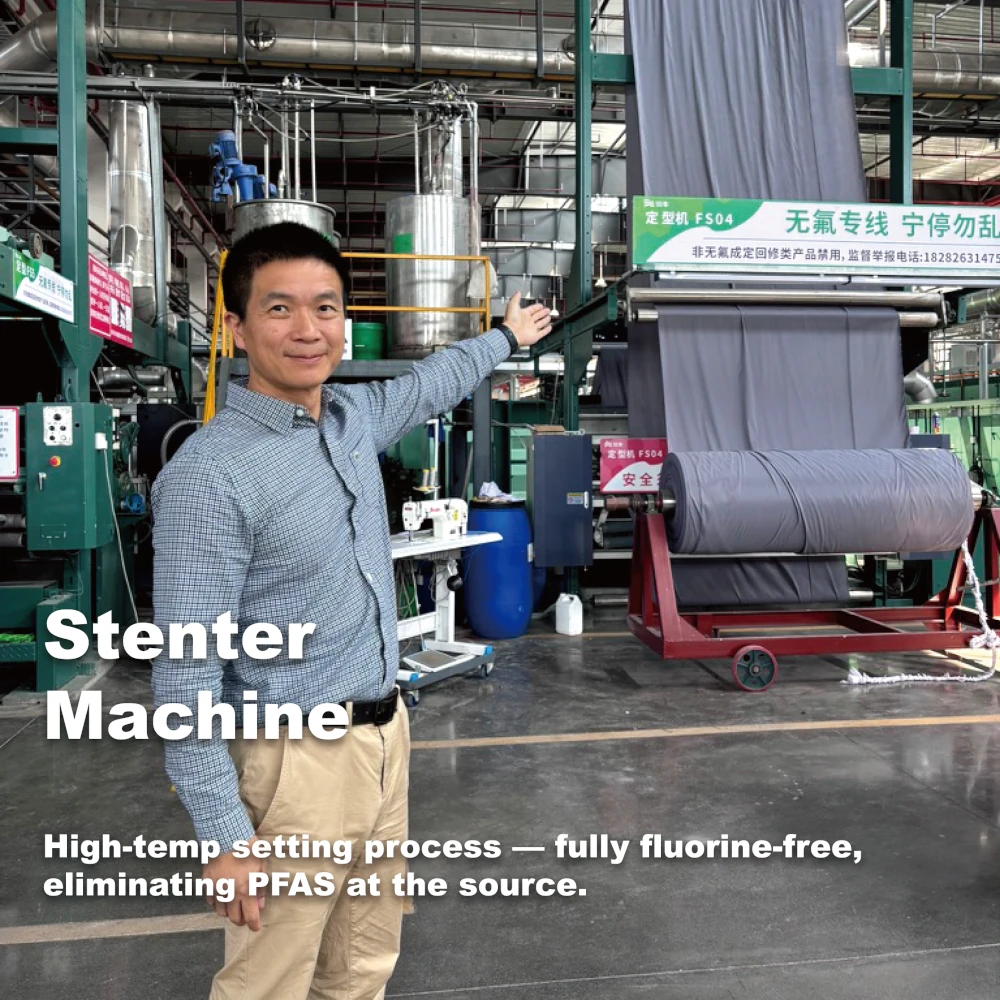
PFAS-Free Stenter Machine — used exclusively for fluorine-free fabric finishing. The stenter frames and tensions the fabric to the correct width while applying heat to cure the C0 DWR treatment.
The stenter machine is the central piece of equipment in the DWR finishing process. After the fabric has been padded with the C0 coating agent, it enters the stenter, which holds the fabric at the correct width under tension as it passes through a series of heated zones. The heat cures the C0 treatment — bonding the fluorine-free water repellent agent to the fiber surface — and dries the fabric in a single continuous pass. Temperature, air volume, and line speed are all controlled parameters that determine the durability and uniformity of the finished coating. This stenter is dedicated to PFAS-free production; it has not been used with fluorinated finishing agents.
2. PFAS-Free Stenter Line
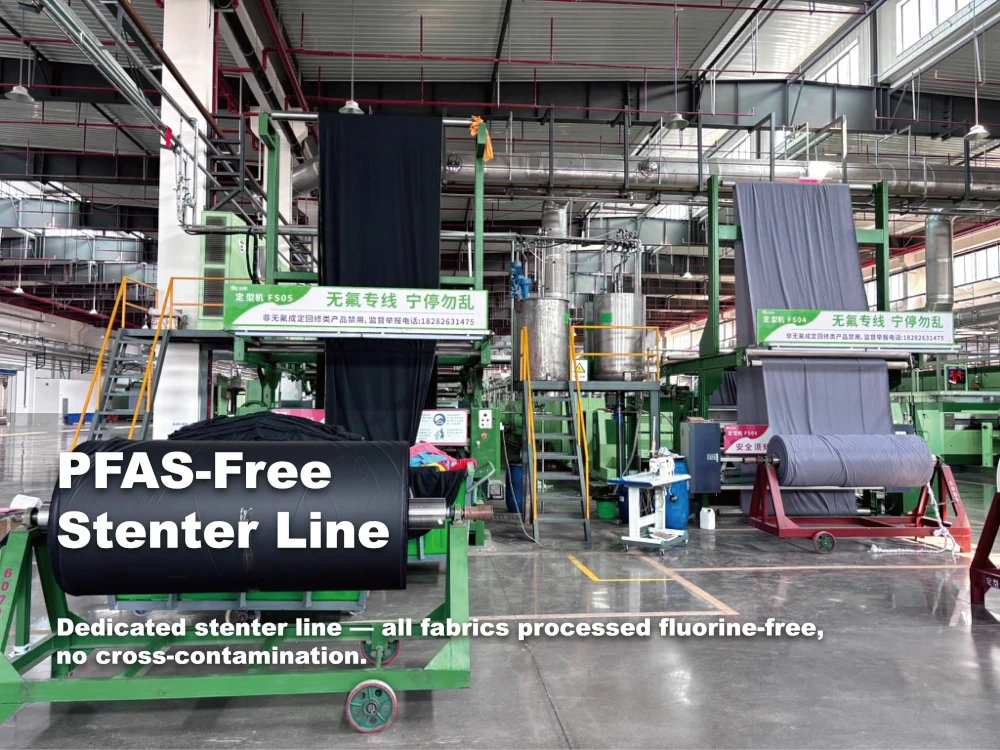
PFAS-Free Stenter Line — the full line view showing fabric feed, heating chambers, and exit section. Continuous production with logged process parameters for each batch.
The full stenter line view shows the scale of the operation and the continuous nature of the process. Fabric enters at the feed end, passes through the heating chambers, and exits at the correct finished width with the C0 treatment fully cured. Each production run is logged — temperature profile, dwell time, and line speed — creating a documented record that accompanies the batch through to final SGS testing. This documentation trail is part of what we provide to buyers as process-level evidence alongside the SGS test report.
3. PFAS-Free Line Testing Equipment
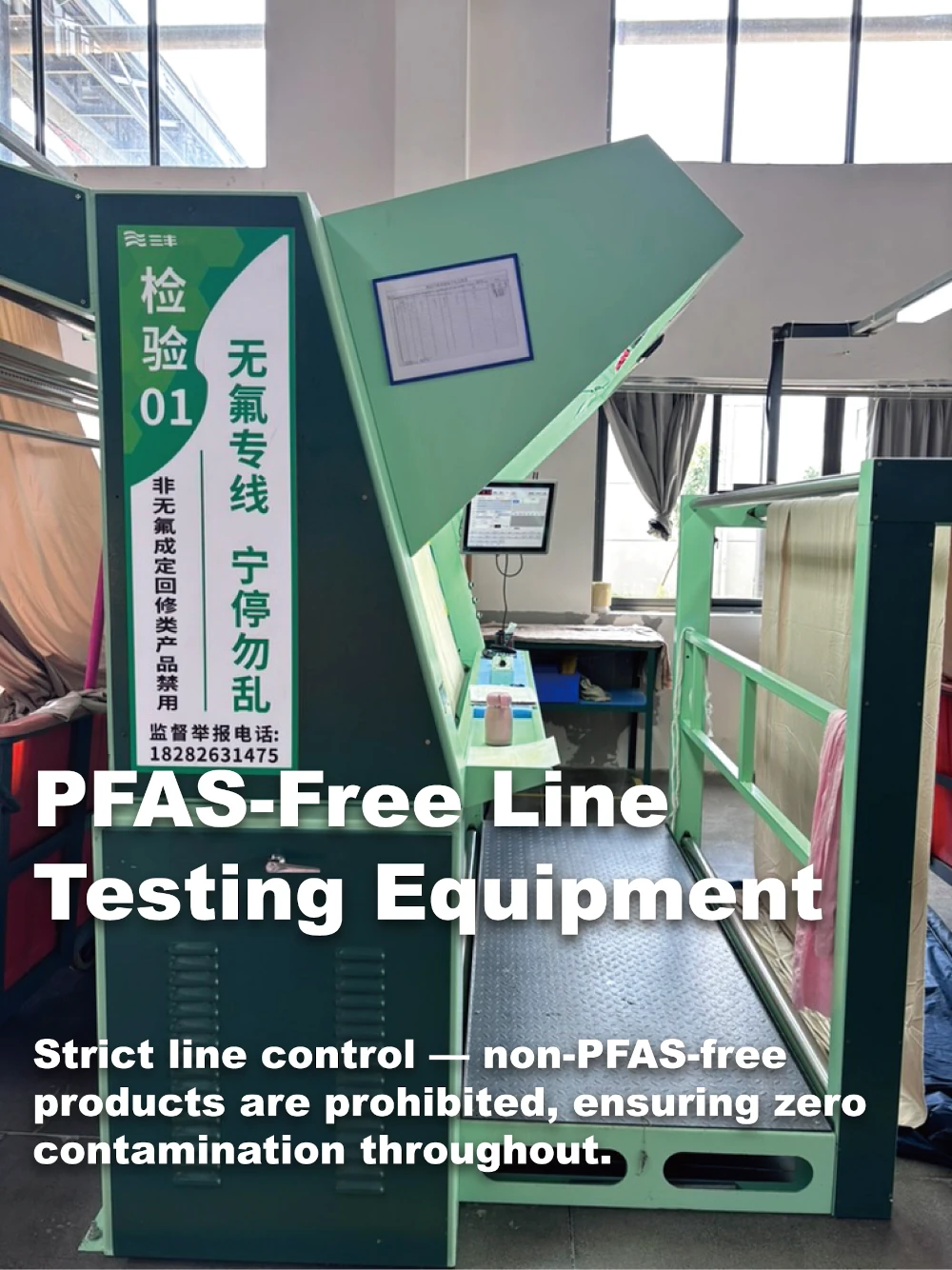
PFAS-Free Line Testing Equipment — in-process testing instruments used to verify coating performance at the production stage, before fabric is advanced to the next step.
In-process testing sits alongside the production line, not at the end of it. After the stenter, fabric samples are pulled at regular intervals and tested for water repellency performance using the spray test method (ISO 4920). This gives the production team immediate feedback: if the coating performance is below threshold, adjustments can be made to process parameters before a full batch of fabric is committed. Fabric that does not pass in-process testing does not advance to finishing, cutting, or assembly. The testing equipment shown here is part of the PFAS-free line's quality infrastructure — not shared with fluorinated chemistry processes.
4. Fluorine-Free Water Repellent Outlet
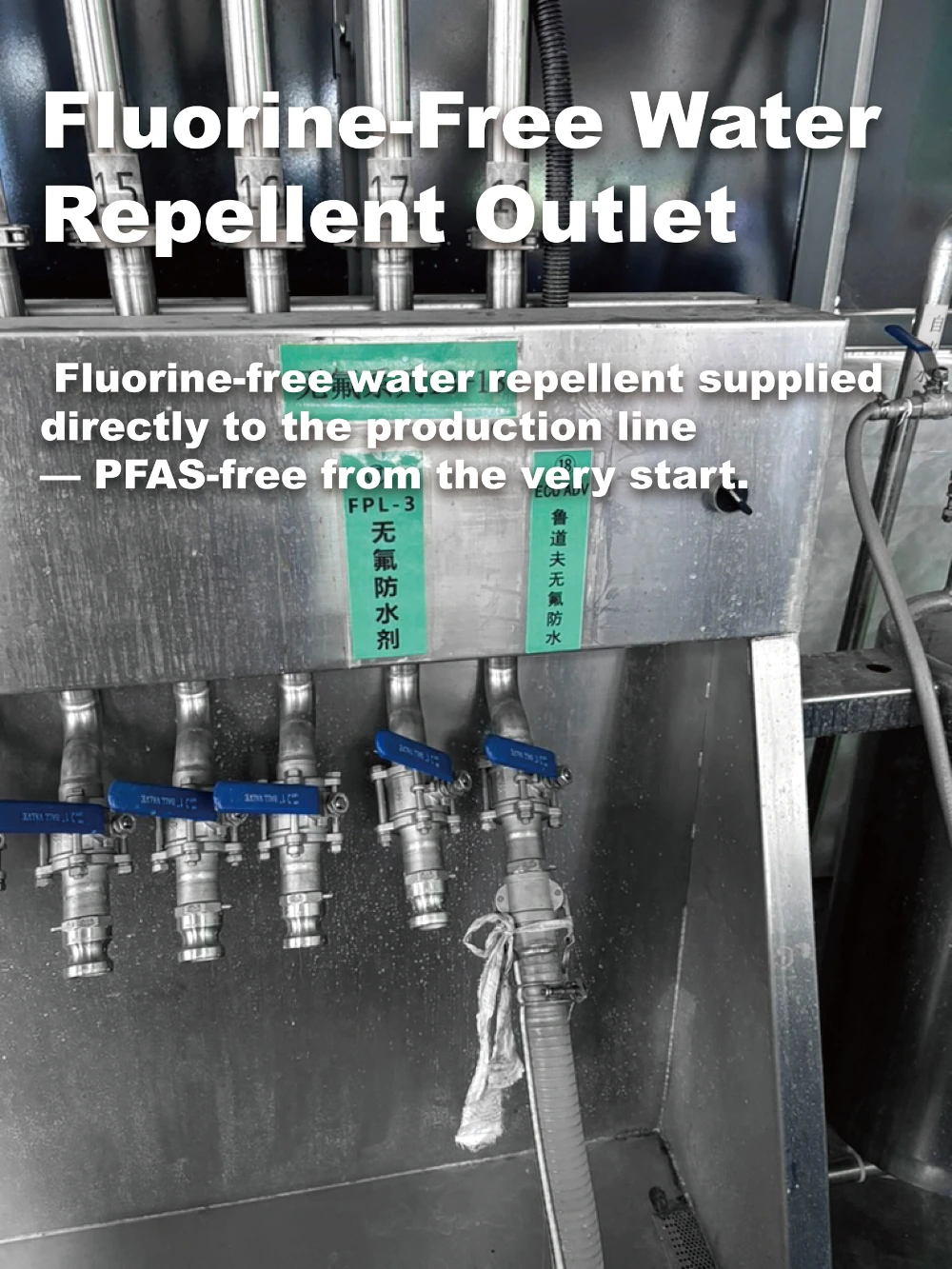
Fluorine-Free Water Repellent Outlet — the delivery point for C0 DWR chemistry into the padding bath. Dedicated pipework and outlet used exclusively for fluorine-free agents.
The water repellent outlet is the point at which the C0 DWR chemical agent enters the padding bath. In a shared production environment, this pipework and its associated tanks are a primary contamination risk — fluorinated residues from previous chemistry persist in pipes and valves even after flushing. On this dedicated line, the outlet and its entire delivery system have been used exclusively with fluorine-free agents. This is the kind of infrastructure detail that does not appear on a test report but directly determines whether the PFAS-free claim holds throughout the production process.
5. PFAS-Free Overflow Dyeing Machine
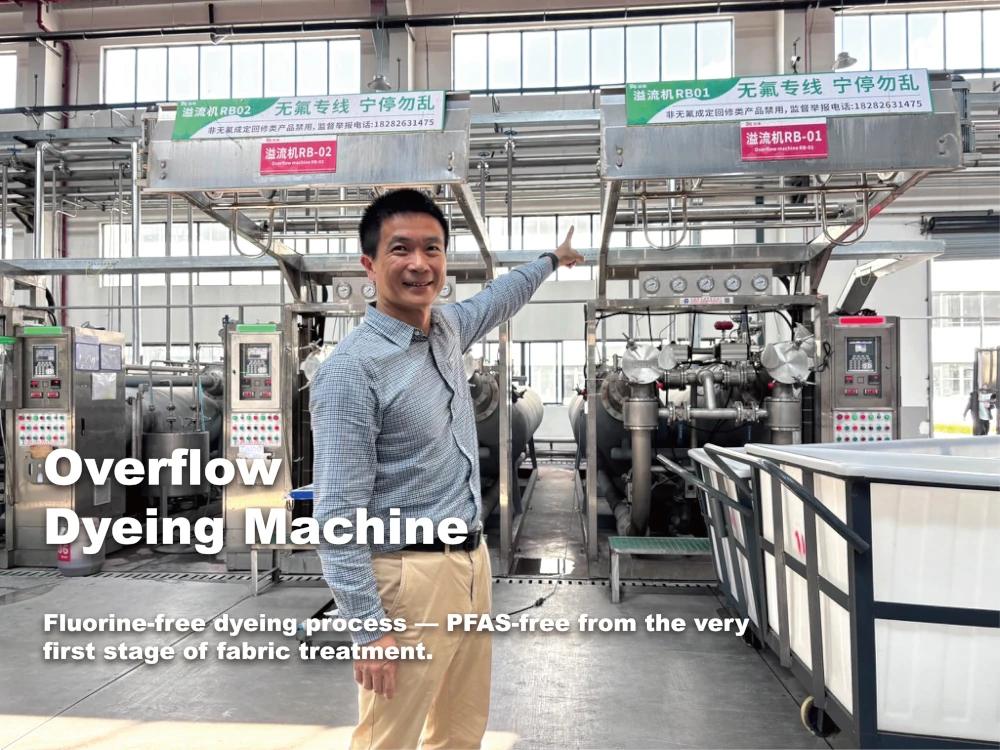
PFAS-Free Overflow Dyeing Machine — used for fabric dyeing prior to the DWR finishing stage. Fluorine-free chemistry is maintained across the entire upstream process, not just at the coating step.
PFAS compliance in fabric production is not limited to the DWR coating stage. The dyeing process that precedes it must also be conducted without introducing fluorinated compounds. The overflow dyeing machine shown here is part of the same dedicated PFAS-free line — meaning the fabric's PFAS-free status is maintained from dyeing through to finished coating, not just at the final treatment step. Overflow dyeing is used for continuous, even color application across fabric lengths; the machine circulates fabric through the dye liquor in a gentle, low-tension process that preserves fabric hand and weave integrity before the stenter finishing stage.
6. PFAS-Free Line Control Station
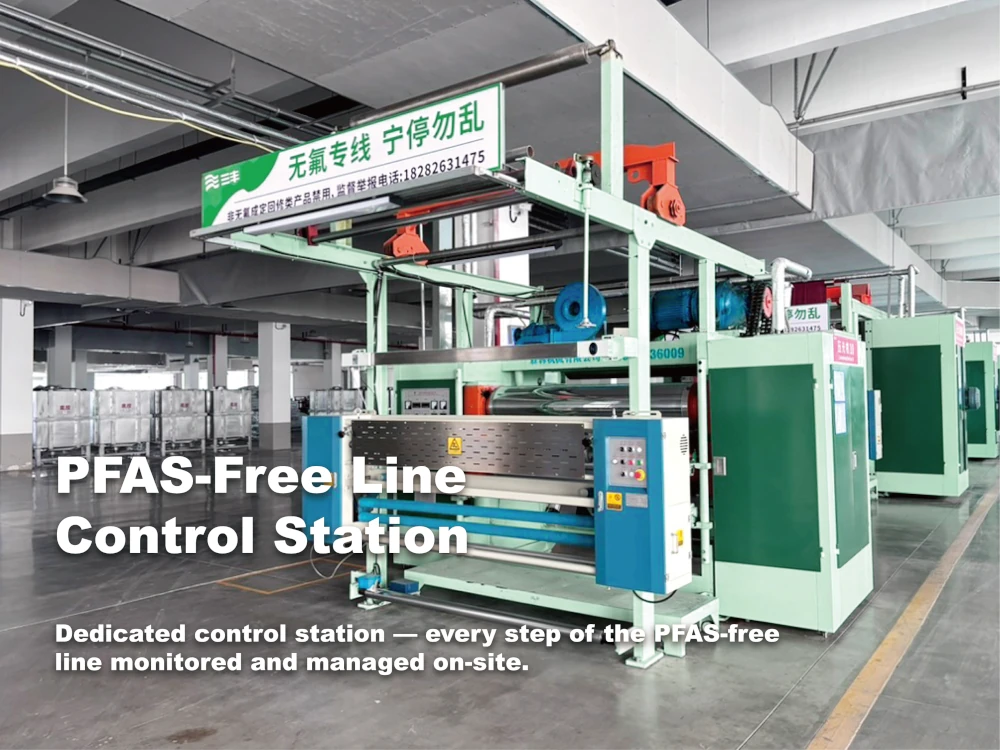
PFAS-Free Line Control Station — centralized process monitoring and parameter control for the dedicated fluorine-free production line.
The control station is where stenter temperature, line speed, air volume, and bath concentration are monitored and adjusted in real time. Each of these parameters affects the durability and evenness of the C0 DWR coating — and logged control data from each production run becomes part of the batch documentation record. For buyers who request process-level evidence of PFAS-free production, this documentation — alongside the SGS test report — provides a complete chain of evidence from chemistry input through to finished product verification.
7. PFAS-Free Collection Bin
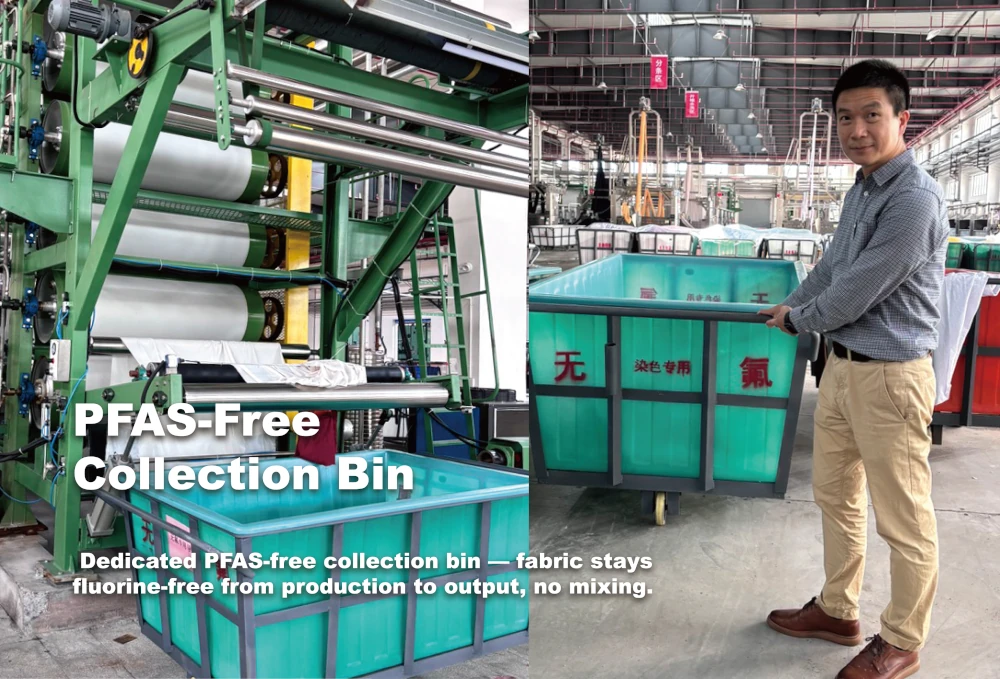
PFAS-Free Collection Bin — finished fabric is collected in dedicated bins used exclusively on the PFAS-free line. Even material handling equipment is kept separate from fluorinated chemistry processes.
Material handling is the final contamination risk point on a production line. Bins, trolleys, and storage racks that have been in contact with PFAS-treated fabric can transfer residues to subsequently processed material. The collection bins used on this line are designated exclusively for PFAS-free output — they have not been used in fluorinated chemistry processes. This level of detail is rarely discussed in product marketing, but it is precisely the kind of process discipline that separates a genuinely PFAS-free production environment from one that has simply switched coating chemistry while maintaining shared infrastructure.
8. PFAS-Free Fabric Washing Machine
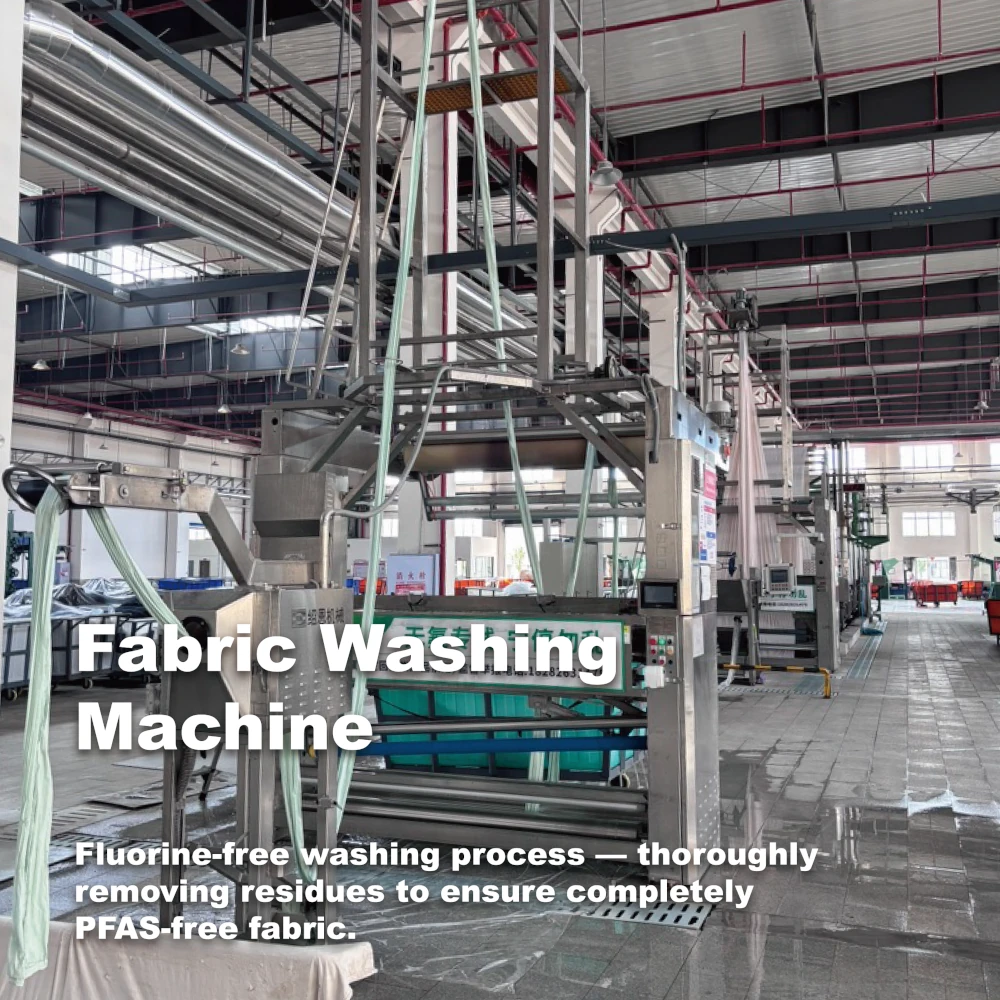
PFAS-Free Fabric Washing Machine — used for pre-treatment washing of fabric prior to dyeing and coating. Dedicated to the fluorine-free line to prevent upstream contamination.
From Fabric to Finished Umbrella: Maintaining PFAS-Free Integrity
The production line shown above covers the fabric stage — washing, dyeing, C0 DWR coating, and stenter finishing. Once the fabric has passed in-process testing and been confirmed for release, it moves to Topumbrella's umbrella assembly facility. At this stage, maintaining PFAS-free integrity requires the same materials discipline applied in the fabric workshop: verified PFAS-free thread, hardware, and any additional treatments applied to frame or handle components.
Before finished umbrellas are released for sale or shipment, a canopy sample from each production lot is submitted to SGS for independent PFAS testing. The SGS test screens for over 40 PFAS compounds to the limits of detection under REACH testing standards. Only lots with a confirmed pass are designated as our certified PFAS-free product line. The test report — which specifies the product, test method, and result — is available to buyers on request and is suitable for inclusion in retail compliance submissions and ESG documentation packs.
→ View our SGS-certified PFAS-free folding umbrella — the finished product from this production process — with full specifications and sample request details.
What Procurement Teams Can Request from Us
SGS PFAS Test Report: Independent third-party test result confirming zero detectable PFAS on the finished umbrella canopy, conducted to REACH standards by SGS. Available for each certified product lot on request.
Process Documentation: Batch production logs, stenter process parameters, and in-process test records — supporting the chain of evidence from chemistry input through to finished product verification.
Restricted Substance List (RSL): Material-level RSL declarations covering canopy fabric, thread, handles, and frame components — confirming PFAS-free status across the full bill of materials, not just the canopy coating.
OEM Custom Programs: PFAS-free fabric available across our custom umbrella programs — full color, logo printing, handle configuration, and branded packaging. MOQ from 500 pcs. Free sample available. View certified product →
Request SGS Documentation or a Factory Quote
Our PFAS-free umbrella program includes full SGS test reports, process documentation, and OEM customization from 500 pcs. Contact us to discuss your requirements.
Get in Touch →


